

Every January, millions of people vow to clean up their diet with fewer empty calories, more balance, better long-term habits. But while we focus on detoxing our plates, our portfolios are often left bloated with hidden concentrations.
 Portfolios deserve the same treatment. As 2026 begins, many investors are revisiting their core allocations and discovering something unexpected: hidden concentrations that have quietly reshaped their exposure to U.S. large-cap equities.
The S&P 500 Has Changed - Even If Investors Haven’t
The traditional S&P 500 remains a widely used benchmark, but its internal structure has shifted. A small group of mega-cap companies, often referred to collectively as the “Magnificent Seven,” now represents an outsized portion of the index’s total weight. Several of the largest constituents have grown to dominate index performance and risk characteristics.
As a result, investors using cap-weighted exposure may hold a significantly larger allocation to these companies than they realize. What appears diversified on paper may function more like a concentrated bet. Just like stepping on the scale after the holidays, many investors are discovering concentrations they didn’t mean to indulge in.
For advisors, this creates a challenge: how to maintain broad large-cap exposure without allowing unintended overweights to shape portfolio outcomes.
A Rules-Driven Way to Reduce Concentration
The Stratified LargeCap Index ETF (SSPY) and the Stratified LargeCap Hedged ETF (SHUS) offer an alternative approach. Instead of allowing company size to dictate portfolio weight, both ETFs use a proprietary Stratified weighting methodology that divides the S&P 500 into equal economic groups.
Stratified's sector weighting of the S&P 500 focuses on distributing investments across the 8 different sectors in a way that aims to reduce concentration risk and enhance diversification. Instead of following traditional market cap weighting, which can lead to heavy reliance on a few large sectors, Stratified’s approach often equalizes exposure to various sectors, with the goal of having a more balanced impact on the overall index performance.
Stratified Weighting defines sector neutrality in an absolute, not relative, sense. Each of the eight primary FIS sectors is assigned an equal weight of 12.5% of the index. This equal weighting process continues within each primary sector’s subsectors. For example, Financials has three subsectors (Banking, Real Estate, and Insurance), so the target weight for each is about 4.17% (12.5% / 3). In total, each primary sector is subdivided into an additional four levels.
The result is an index that seeks more balanced representation across sectors and company sizes within the large-cap universe without needing investors to abandon familiar territory.
Think of it as a “portfolio diet” not focused on cutting exposure, but on redistributing it more evenly.
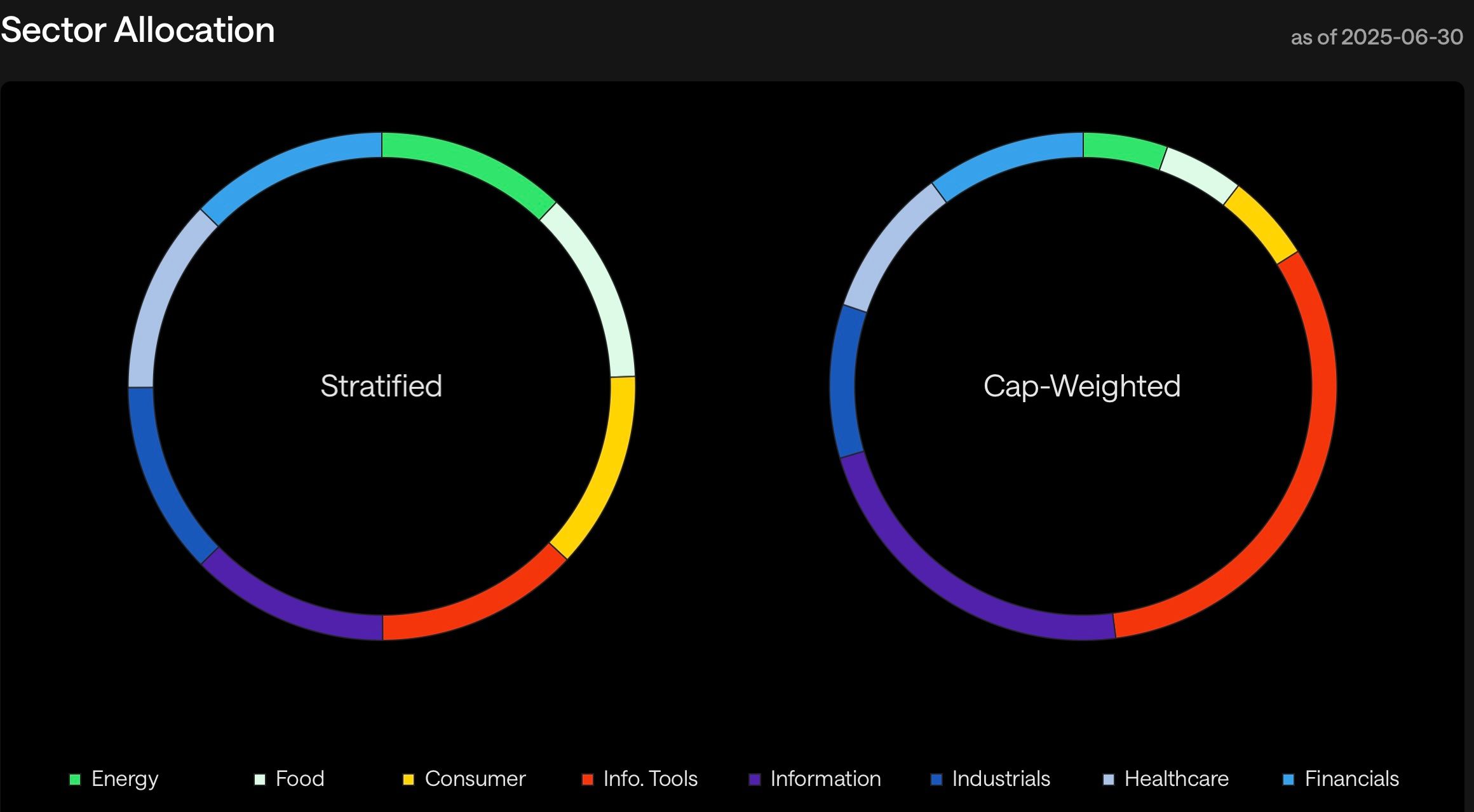
Image Source: Syntax Data
Reconsidering Concentration in 2026
Many investors are taking a fresh look at index construction as they evaluate risk budgeting, portfolio sturdiness, and diversification assumptions. Several themes stand out:
- Unintended overweights in mega-caps may not align with an investor’s intended risk profile.
- Market leadership changes can magnify concentration effects.
- Systematic rebalancing as used in Stratified’s methodologies, helps maintain consistent diversification.
- Hedging tools, such as the overlay used in SHUS, offer an additional mechanism designed to help manage broad-market risk.
In an environment where investors seek clarity and control, structure matters. How an index allocates weight may be as important as what stocks it holds.
A Clean Start for the New Year
Portfolios evolve over time, sometimes in ways investors don’t notice. A January reset offers an opportunity to reassess whether core allocations still reflect their purposes. For those seeking large-cap exposure with reduced concentration to the largest U.S. companies, SSPY and SHUS seek to provide systematic, transparent frameworks designed to rebalance weight back toward the broader market.
The “Portfolio Diet” isn’t about restriction. It’s about removing unintended excess and creating room for a more deliberate, balanced approach to equity investing.
Scan the menu: Explore the holdings that make up SSPY and SHUS.

Investors should consider the investment objectives, risks, charges and expenses carefully before investing. For a prospectus or summary prospectus with this and other information about the Fund, please call (866) 972-4492 or visit our website at https://stratifiedfunds.com/investor-materials. Read the prospectus or summary prospectus carefully before investing.
The Funds are distributed by Foreside Fund Services, LLC. Exchange Traded Concepts, LLC serves as the investment advisor. Foreside Fund Services, LLC. is not affiliated with Exchange Traded Concepts, LLC or any of its affiliates.
Investing involves risk, including loss of principal. The Funds are subject to certain other risks, including but not limited to, equity securities risk, large-capitalization risk, index tracking risk, passive strategy/index risk, and market trading risk. Investing involves risk, including possible loss of principal. There can be no guarantee the Fund will meet its investment objectives.
SSPY Risks: The Fund is subject to certain other risks, including but not limited to, equity securities risk, large-capitalization risk, index tracking risk, passive strategy/index risk, and market trading risk. Investing involves risk, including possible loss of principal.
SHUS Risks: The Fund is actively managed using a proprietary process, and there can be no guarantee that the Fund's investment strategies will be successful. The Fund may invest in Underlying Funds or Securities that are managed with a passive investment strategy, attempting to track the performance of an unmanaged index of securities. This differs from an actively-managed fund, which typically seeks to outperform a benchmark index. Maintaining investments in securities regardless of their individual performance or market conditions could negatively affect the Fund's return. The Fund is subject to certain other risks, including but not limited to, equity securities risk, large-, mid-, and small-capitalization risk, and market trading risk. Investing in securities of small and mid-sized companies may involve greater volatility than investing in larger and more established companies. Certain investments may be subject to restrictions on resale, trade over-the-counter or in limited volume, or lack an active trading market. Purchased put options may expire worthless and may have imperfect correlation to the value of the Fund’s sector based investments. Written call and put options may limit the Fund’s participation in equity market gains and may amplify losses in market declines. The Fund’s losses are potentially large in a written put or call transaction. If unhedged, written calls expose the Fund to potentially unlimited losses. The Fund invests in derivatives. Derivatives are financial instruments that derive their performance from an underlying reference asset, such as an index. The return on a derivative instrument may not correlate with the return of its underlying reference asset. Derivatives can be volatile and may be less liquid than other securities.
Shares are bought and sold at market price (not NAV) and are not individually redeemed from the Fund. Investors may purchase or sell individual shares on an exchange on which they are listed. The market price returns are based on the official closing price of an ETF share or, if the official closing price isn’t available, the midpoint between the national best bid and national best offer (“NBBO”) as of the time the ETF calculates current NAV per share, and do not represent the returns you would receive if you traded shares at other times. NAVs are calculated using prices as of 4:00 PM Eastern Time.
The Syntax Stratified LargeCap Index™ is the property of Syntax, LLC, which has contracted with S&P Opco, LLC (a subsidiary of S&P Dow Jones Indices LLC) to calculate and maintain the Index. The Index is not sponsored by S&P Dow Jones Indices or its affiliates or its third-party licensors (collectively, “S&P Dow Jones Indices”). S&P Dow Jones Indices will not be liable for any errors or omissions in calculating the Index. “Calculated by S&P Dow Jones Indices” and the related stylized mark(s) are service marks of S&P Dow Jones Indices and have been licensed for use by Syntax, LLC, the parent company of Syntax Advisors, LLC. S&P® is a registered trademark of Standard & Poor’s Financial Services LLC (“SPFS”), and Dow Jones® is a registered trademark of Dow Jones Trademark Holdings LLC (“Dow Jones”).
The Syntax Stratified LargeCap Index™ is the property of Syntax, LLC, the Fund’s index provider. Syntax®, Stratified®, Stratified Indices®, Stratified Weight™, and FIS™ are trademarks or registered trademarks of Locus LP. Performance of an index is not illustrative of any particular investment. It is not possible to invest directly in an index.
Stratified Weight™ is the weighting methodology by which Syntax diversifies an index’s constituent companies that share “Related Business Risks.” Related Business Risk occurs when two or more companies provide similar products and/or services or share economic relationships such as having common suppliers, customers or competitors. The process of identifying, grouping, and diversifying holdings across Related Business Risk groups within an index is called stratification, and was designed by Syntax to seek to correct for business risk concentrations that regularly occur in capitalization-weighted indices and equal-weighted indices.
The Stratified Hedged Strategy combines the benefits of exposure to a Stratified Weight™ equity portfolio with a rules-based downside hedge program managed by Exchange Traded Concepts to reduce the risk of losses due to market downturns.
Diversification does not ensure a profit or guarantee against a loss.
The S&P 500® Index is a market-capitalization-weighted index of the 500 leading publicly traded companies in the U.S.
© Copyright 2026 Exchange Traded Concepts. All Rights Reserved | Privacy Policy