

In investing, timing often gets all the attention.
 People try to predict market highs and lows, get out before the storm and back in before the sunshine. It feels proactive almost heroic to make that perfect move before everyone else. But the reality is far less glamorous. History shows that even the most seasoned investors can’t reliably time the market. What truly matters isn’t when you invest - it’s that you stay invested.
The old saying goes, “It’s not about timing the market, it’s time in the market.” That wisdom remains as relevant as ever. Staying invested allows compounding, the real engine of wealth creation, to do its job. Yet staying invested can be emotionally difficult when volatility hits. That’s where a disciplined strategy like the Stratified LargeCap Hedged ETC (SHUS) may help make all the difference.
The Cost of Missing the Market’s Best Days
Consider this: if you had invested $10,000 in the S&P 500 and left it untouched for 20 years, your investment would have grown to $64,844. But if you missed just the 10 best market days, your return would have been cut in half. Miss the 60 best days, and that $10,000 would have dwindled to just $4,205. [1]
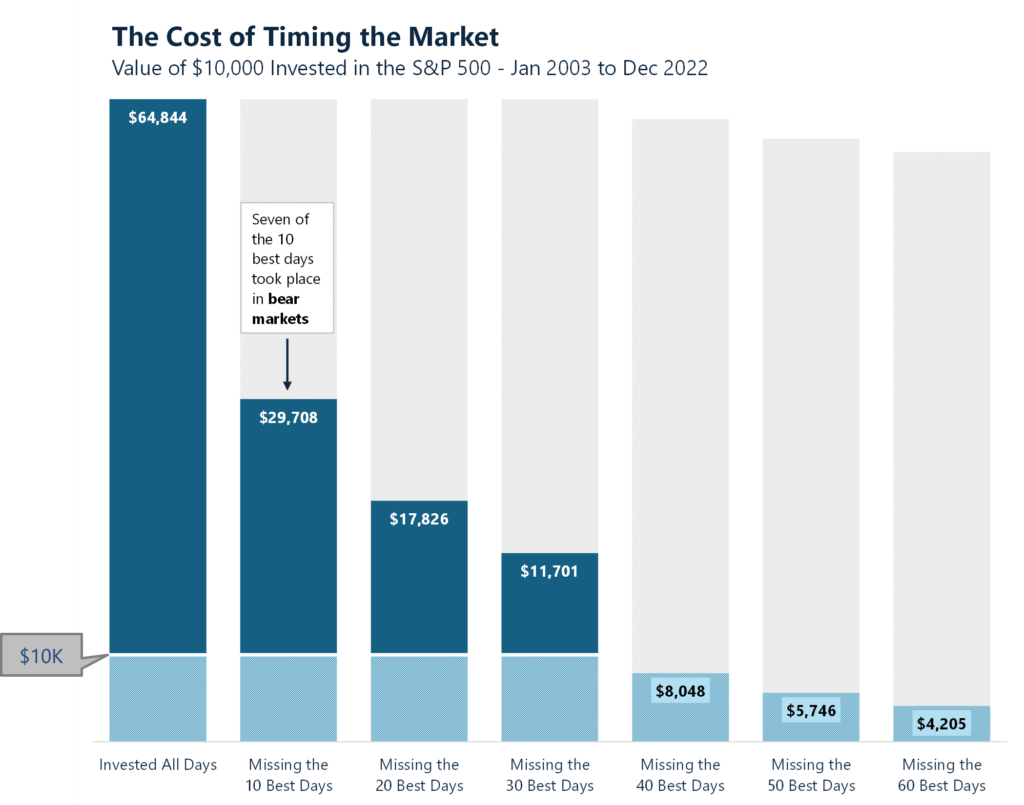
Past performance is no guarantee of future results. Source: RiskBridge, JP Morgan, data from January 2003 to December 2022.
That’s not a rounding error, it’s a complete change in outcome. The reason? The best market days often occur close to the worst ones. Investors who sell during downturns frequently miss the powerful rebounds that follow. Missing just a handful of these moments can have a long-term impact on performance.
Hedging Isn’t Bearish. It’s Balanced.
Hedging often gets an undeserved reputation as a “bearish” move, something to do only when you expect markets to fall. But that’s the wrong lens. In reality, hedging is a discipline, not a direction. It’s a framework for tempering volatility and emotion, allowing investors to stay the course through all market cycles.
The Stratified LargeCap Hedged ETC (SHUS) embodies this approach. By maintaining exposure to U.S. large-cap equities while systematically applying a hedge, SHUS seeks to reduce downside risk without requiring investors to time their entry or exit. In other words, it seeks to help investors remain invested when markets get “hairy,” tightening the seatbelt rather than exiting the vehicle.
The Power of Stratified’s Equal-Weight Approach
Beyond the hedge, SHUS incorporates Stratified’s equal-weight strategy, a powerful differentiator that helps avoid concentration risk inherent in traditional market-cap-weighted indexes. By rebalancing across sectors and companies, the strategy ensures no single mega-cap name dominates performance.
This systematic, rules-based structure encourages discipline at both ends of the cycle, trimming excess when markets overextend and leaning into opportunity when others pull back. The result is a balanced exposure that may align naturally with potential long-term portfolio resilience.
The Power of Staying the Course
In a world where market narratives change by the hour, SHUS may help advisors and their clients focus on what doesn’t change: the value of staying the course. Because investing success doesn’t come from predicting the next move, it comes from maintaining conviction through every cycle.
The Stratified LargeCap Hedged ETC (SHUS) built for time in the market, not timing the market. Learn more about SHUS here.
Source:
[1] RiskBridge, JP Morgan, data from January 2003 to December 2022.

Investors should consider the investment objectives, risks, charges and expenses carefully before investing. For a prospectus or summary prospectus with this and other information about the Fund, please call (866) 972-4492 or visit our website at https://stratifiedfunds.com/investor-materials. Read the prospectus or summary prospectus carefully before investing.
The Funds are distributed by Foreside Fund Services, LLC. Exchange Traded Concepts, LLC serves as the investment advisor. Foreside Fund Services, LLC. is not affiliated with Exchange Traded Concepts, LLC or any of its affiliates.
Investing involves risk, including loss of principal. The Funds are subject to certain other risks, including but not limited to, equity securities risk, large-capitalization risk, index tracking risk, passive strategy/index risk, and market trading risk. Investing involves risk, including possible loss of principal. There can be no guarantee the Fund will meet its investment objectives.
SSPY Risks: The Fund is subject to certain other risks, including but not limited to, equity securities risk, large-capitalization risk, index tracking risk, passive strategy/index risk, and market trading risk. Investing involves risk, including possible loss of principal.
SHUS Risks: The Fund is actively managed using a proprietary process, and there can be no guarantee that the Fund's investment strategies will be successful. The Fund may invest in Underlying Funds or Securities that are managed with a passive investment strategy, attempting to track the performance of an unmanaged index of securities. This differs from an actively-managed fund, which typically seeks to outperform a benchmark index. Maintaining investments in securities regardless of their individual performance or market conditions could negatively affect the Fund's return. The Fund is subject to certain other risks, including but not limited to, equity securities risk, large-, mid-, and small-capitalization risk, and market trading risk. Investing in securities of small and mid-sized companies may involve greater volatility than investing in larger and more established companies. Certain investments may be subject to restrictions on resale, trade over-the-counter or in limited volume, or lack an active trading market. Purchased put options may expire worthless and may have imperfect correlation to the value of the Fund’s sector based investments. Written call and put options may limit the Fund’s participation in equity market gains and may amplify losses in market declines. The Fund’s losses are potentially large in a written put or call transaction. If unhedged, written calls expose the Fund to potentially unlimited losses. The Fund invests in derivatives. Derivatives are financial instruments that derive their performance from an underlying reference asset, such as an index. The return on a derivative instrument may not correlate with the return of its underlying reference asset. Derivatives can be volatile and may be less liquid than other securities.
Shares are bought and sold at market price (not NAV) and are not individually redeemed from the Fund. Investors may purchase or sell individual shares on an exchange on which they are listed. The market price returns are based on the official closing price of an ETF share or, if the official closing price isn’t available, the midpoint between the national best bid and national best offer (“NBBO”) as of the time the ETF calculates current NAV per share, and do not represent the returns you would receive if you traded shares at other times. NAVs are calculated using prices as of 4:00 PM Eastern Time.
The Syntax Stratified LargeCap Index™ is the property of Syntax, LLC, which has contracted with S&P Opco, LLC (a subsidiary of S&P Dow Jones Indices LLC) to calculate and maintain the Index. The Index is not sponsored by S&P Dow Jones Indices or its affiliates or its third-party licensors (collectively, “S&P Dow Jones Indices”). S&P Dow Jones Indices will not be liable for any errors or omissions in calculating the Index. “Calculated by S&P Dow Jones Indices” and the related stylized mark(s) are service marks of S&P Dow Jones Indices and have been licensed for use by Syntax, LLC, the parent company of Syntax Advisors, LLC. S&P® is a registered trademark of Standard & Poor’s Financial Services LLC (“SPFS”), and Dow Jones® is a registered trademark of Dow Jones Trademark Holdings LLC (“Dow Jones”).
The Syntax Stratified LargeCap Index™ is the property of Syntax, LLC, the Fund’s index provider. Syntax®, Stratified®, Stratified Indices®, Stratified Weight™, and FIS™ are trademarks or registered trademarks of Locus LP. Performance of an index is not illustrative of any particular investment. It is not possible to invest directly in an index.
Stratified Weight™ is the weighting methodology by which Syntax diversifies an index’s constituent companies that share “Related Business Risks.” Related Business Risk occurs when two or more companies provide similar products and/or services or share economic relationships such as having common suppliers, customers or competitors. The process of identifying, grouping, and diversifying holdings across Related Business Risk groups within an index is called stratification, and was designed by Syntax to seek to correct for business risk concentrations that regularly occur in capitalization-weighted indices and equal-weighted indices.
The Stratified Hedged Strategy combines the benefits of exposure to a Stratified Weight™ equity portfolio with a rules-based downside hedge program managed by Exchange Traded Concepts to reduce the risk of losses due to market downturns.
Diversification does not ensure a profit or guarantee against a loss.
The S&P 500® Index is a market-capitalization-weighted index of the 500 leading publicly traded companies in the U.S.
© Copyright 2026 Exchange Traded Concepts. All Rights Reserved | Privacy Policy